

E-E-A-T Signals: How to Build Author Authority for India SEO
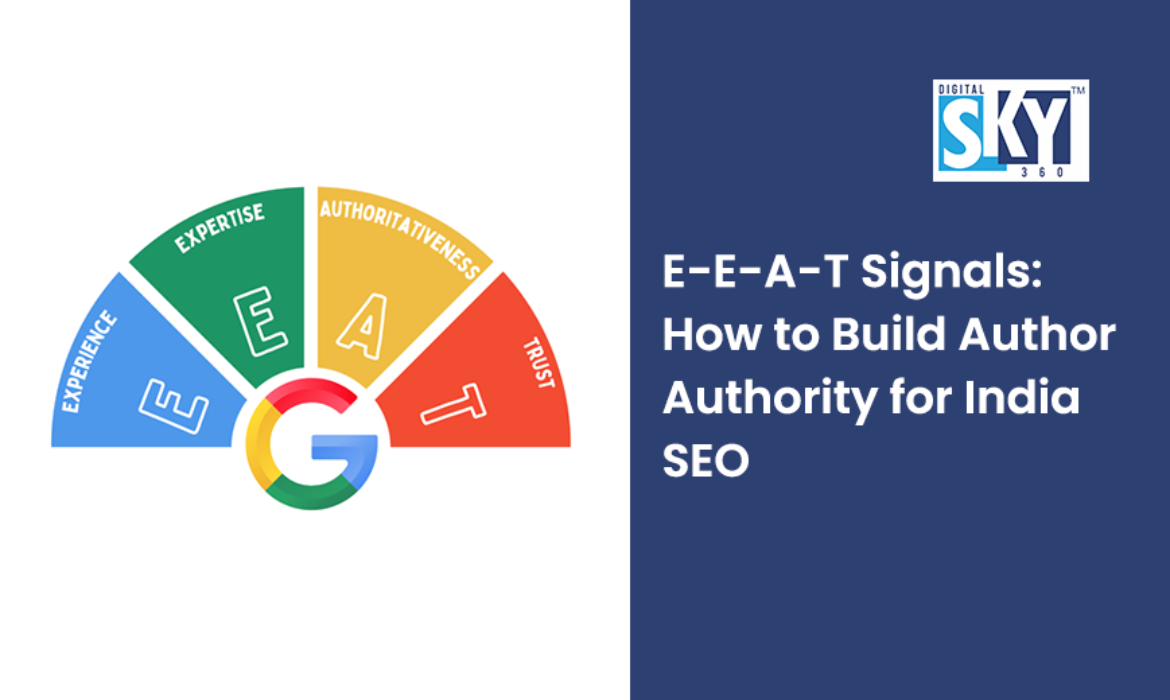
Imagine you just Googled “best mutual funds in India 2025” and the top result was written by someone whose bio reads: “Hi, I am Ravi. I like finance and cricket.” You’d close that tab faster than a WhatsApp forward from your relatives at 6 AM. Google feels exactly the same way — and that’s precisely why E-E-A-T exists.
If your content strategy is still stuck in the era of keyword stuffing and spinning articles, welcome to the rude awakening. Google’s E-E-A-T framework — Experience, Expertise, Authoritativeness, and Trustworthiness — has quietly become the single most important quality signal for ranking in India’s fiercely competitive search landscape. And the good news? Building it isn’t rocket science. It just requires being genuinely, demonstrably good at what you do.
Let’s break it all down.
What Exactly Is E-E-A-T, and Why Should Indian Marketers Care?
Google’s Search Quality Rater Guidelines use E-E-A-T to evaluate whether content genuinely helps users — or just exists to game algorithms. The extra “E” for Experience was added in late 2022, signalling a major shift: Google now wants proof that the author has lived the topic, not just read about it.
For India SEO, this matters enormously. India has one of the fastest-growing internet user bases in the world, with millions of new users coming online every year through regional languages, voice search, and mobile-first browsing. The content landscape is exploding — which means so is the competition. Standing out requires more than good writing. It requires credibility signals that both humans and algorithms can verify.
The Four Pillars — Explained for the Indian Context
1. Experience: “Have You Actually Done This?”
Google’s algorithms, especially for YMYL (Your Money or Your Life) topics — finance, health, law, education — want signals that the author has personal, first-hand experience.
For Indian publishers, this means:
- A travel blogger writing about visiting Ladakh should mention specific roads, dhaba stops, or border permit experiences — not just lifted facts.
- A finance writer covering SIPs should ideally be an investor themselves, with author bios and disclosures that reflect that.
- A cooking blogger writing about Maharashtrian recipes should demonstrate regional knowledge that only someone who grew up eating puran poli would know.
Think of it as the difference between a restaurant review written by a food critic who visited versus someone who read the Zomato listing. Google is getting scarily good at telling them apart.
2. Expertise: “Do You Know Your Subject?”
Expertise is about depth and accuracy. This is where On-page SEO plays a silent but powerful role — not just in keyword placement, but in how content is structured to demonstrate command of a topic.
Use proper heading hierarchies. Cite original sources like RBI reports, SEBI circulars, ICMR data, or government press releases. Write content that answers the next question the reader hasn’t asked yet. Interlink related articles to form topical clusters. These are signals Google’s crawlers read as markers of a knowledgeable source.
For Indian SEO, regional expertise matters too. A legal blog writing about property disputes should show familiarity with state-specific laws — not just copy-paste central government guidelines.
3. Authoritativeness: “Does the Internet Agree You Know This?”
This is the part most Indian content creators underestimate. Authoritativeness is built externally — through backlinks from credible Indian domains (.gov.in, leading news portals, educational institutions), media mentions, citations, and community recognition.
If you’re trying to grow a brand’s authority in a particular niche, you need a PR and digital strategy working alongside SEO. A digital marketing agency in Ahmedabad that combines link-building with content PR will typically outperform one that treats them as separate workstreams. Authority isn’t declared — it’s earned and referenced by others.
Get your authors quoted in The Hindu, Mint, or YourStory. Appear on Indian podcasts. Contribute to industry roundtables. These aren’t just vanity wins — they’re trust signals Google’s algorithms actively track.
4. Trustworthiness: “Can the Reader Rely on This?”
Trust is the glue that holds E-E-A-T together — and it’s built through transparency. For Indian websites, this means:
- Clear, verifiable author bios with LinkedIn profiles and credentials
- Accurate, regularly updated content (especially crucial in a market where policies, tax laws, and regulations change often)
- HTTPS-secured websites with clear privacy policies
- Transparent corrections and editorial policies
- Contact information that works — not a Gmail address for a “company”
Building Author Authority: A Practical Playbook for Indian Brands
Create Author Entity Pages
Every content creator on your platform needs a dedicated author page — not a two-line filler, but a page that includes credentials, professional history, social proof, and links to verified external profiles. Google uses these pages to associate an author’s identity with their content across the web.
Build Topical Authority Before Chasing Rankings
Instead of writing one blog about “home loans in India,” build a content ecosystem — articles on eligibility criteria, RBI rate impacts, documentation checklists, EMI calculators, lender comparisons. Monitoring key SEO metrics like topical coverage, crawl depth, and internal link equity will show you where authority is concentrated and where gaps exist.
Leverage Author Schema Markup
Technical SEO is non-negotiable. Implement Article and Person schema markup to help Google connect your author’s identity to each piece of content. This is one of the most underused signals in Indian SEO and gives an immediate structural advantage.
Collaborate With Recognised Indian Voices
Co-authorship, guest posts from domain experts (doctors, CAs, lawyers, engineers), and expert quote inclusions dramatically boost E-E-A-T. A blog on tax-saving strategies co-written by a certified CA ranks with inherently more trust than one authored by an anonymous “editorial team.”
E-E-A-T for Small Businesses and Regional Brands
Building authority doesn’t require a corporate budget. Small business SEO thrives on local credibility — Google Business Profile optimisation, customer reviews, local citations, and niche expertise. A homeopathy clinic in Pune that consistently publishes well-researched, experience-driven content on specific conditions — backed by the doctor’s verified credentials — will outrank a generic health portal on those specific local queries.
Similarly, a social media marketing agency in Ahmedabad that shares client success stories, team credentials, and transparent case studies will build E-E-A-T far faster than one hiding behind polished but hollow website copy.
What AI Means for E-E-A-T in India
Here’s the elephant in the room: AI-generated content. With tools flooding the market, Google has doubled down on E-E-A-T precisely because of AI. A well-known seo company in Ahmedabad recently shared that AI-assisted content which lacked human editorial review and author attribution dropped significantly in rankings after Google’s Helpful Content updates — while human-validated, experience-rich content climbed.
The lesson? AI is a production tool, not an authority builder. Use it to draft and research. But the experience, the credentials, and the editorial stamp? That has to be human.
Final Thought: Authority Is Not an Algorithm Hack — It’s a Reputation
E-E-A-T is Google’s way of asking: “Would a real human trust this enough to act on it?” In India’s diverse, multilingual, mobile-first market, the bar for earning that trust is high — and rising.
The brands and creators who invest in building genuine author authority — through visible credentials, real-world experience, external recognition, and transparent communication — will not just rank better. They will deserve to.
And that, in the long run, is the only SEO strategy that survives every algorithm update.