
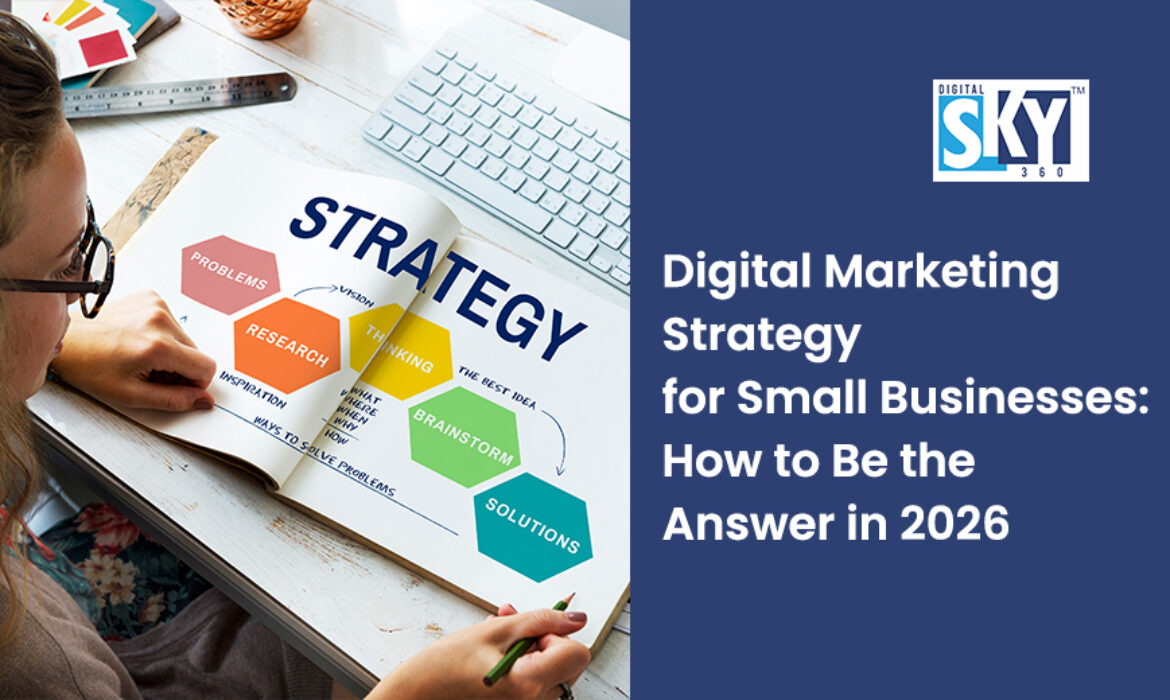
Digital Marketing Strategy for Small Businesses: How to Be the Answer in 2026
The playbook that worked in 2023 is broken. For years, the formula for small business growth was simple: build a website, target a few keywords, and wait for clicks. But in 2026, the internet has shifted from a Search Economy to an Answer Economy.
Your customers are no longer just “Googling” you. They are asking AI assistants for recommendations and searching social platforms for visual proof. This is the same strategic shift we apply when helping small brands through our strategic support as digital marketing agency in Ahmedabad . In this environment, you must move from being a “result” to being the “answer.”
Part 1: The Paradigm Shift
Digital Marketing Strategy for Small Businesses in 2026
The traditional marketing funnel is dead. In 2026, small businesses operate in a “Trust Loop.” A customer might see a short video of your shop, check a Reddit thread for verification, and then ask an AI for a comparison—all before visiting your site.
The Strategy: “Verification Over Visibility” Your goal is no longer just to be seen. It is to be verified. Every piece of content you create must serve as proof. Whether you are a local dental clinic or a boutique accounting firm, AI needs data to verify you, and humans need emotional proof to choose you.
Part 2: The Core Infrastructure
Your Website as a “Data Beacon” (Not a Brochure)
In the past, your website was a showroom. Now, its primary job is to be a structured database for machines. AI scrapers read your site to understand who you are so they can recommend you in voice and chat searches.
1. The “Entity-First” Structure AI views your business as an “Entity”—a collection of facts. Your website must feed these facts clearly using Schema Markup. For a local plumbing company, this means tagging not just “services,” but specific “emergency response times” and “licensed technician IDs.”
2. The “Zero-Click” Landing Page Design your homepage assuming the user will never scroll.
- Instant Answers: “Emergency AC Repair in [City]. 60-minute arrival. Call [Number].”
- Visual Proof: A live-action video of your team at work.
Part 3: AEO (Answer Engine Optimization)
How Small Businesses Should Optimize for AI Search
SEO was about matching keywords. AEO (Answer Engine Optimization) is about providing the definitive answer that AI can extract. Structuring content this way is now a core part of modern SEO strategies, especially for small businesses competing locally.
1. The Q&A Strategy for Local Services For a local pet grooming salon, instead of a page titled “Our Grooming Services,” use “How much does full-service dog grooming cost in [City]?”
- The “BLUF” Method (Bottom Line Up Front): Start with the direct answer.
- Example: “Full-service grooming in [City] typically ranges from $60 to $120 depending on breed size.”
2. Optimizing for “Near Me” Context AI is hyper-local. A neighborhood bakery should create pages referencing local landmarks. “Best sourdough bread near [Central Park]” helps AI triangulate your location relative to the user.
Part 4: The “Human Premium”
Future of Local Digital Marketing
As the internet floods with generic, AI-generated text, “human” content becomes a luxury asset. The more corporate your marketing looks, the less trustworthy it feels.
1. Founder-Led Marketing People trust people, not logos. Whether you run a law firm or a landscaping business, the owner must be the face of the brand. Post weekly 60-second videos explaining a problem you solved. “Real” is better than “Perfect.”
2. “Process” Content Over “Result” Content Don’t just show the clean house; show the cleaning company team in action, using the tools and explaining the process. This “proof of work” proves you aren’t just an AI-generated facade.
Part 5: Video as the New Search Bar
Visual Search and Social proof
Platforms like TikTok and YouTube Shorts are now primary search engines for users under 40. This is where consistent, educational social media marketing becomes a major growth lever for small businesses.
1. Video Metadata is Key Algorithms “listen” to your video. If you are a mechanic, say “brake repair in [City Name]” clearly. The auto-captions pick this up and index your video for that local search.
2. Educational Shorts Stop dancing; start teaching. A real estate agent shouldn’t just show a house; they should explain: “3 things to look for in a 1920s basement before buying.”
Part 6: Data Sovereignty
Owning Your Audience in a Privacy-First World
Tracking cookies are gone. You must own your data to survive. For a local gym or yoga studio, this means moving followers off Instagram and into a list you own.
1. The “Zero-Party” Data Strategy Use interactive tools. A HVAC company could offer a “System Health Quiz.” In exchange for their email, the user gets a personalized estimate of their unit’s remaining lifespan. This is data they voluntarily give you, which is far more valuable than a “like.”
2. Community over Audience Build a “Sunday Runners Club” or a “DIY Homeowners Newsletter.” When you own the communication channel, you are no longer at the mercy of algorithm changes.
Part 7: The “Anti-Fragile” Budget
Smart Spending and Performance Marketing
Stop wasting money on “Brand Awareness.” This is why performance-driven campaigns focused on leads and ROI matter far more than vanity metrics.
1. High-Intent Advertising
- Google Local Service Ads (LSA): These are the “Google Guaranteed” ads at the top of search. For locksmiths, electricians, or painters, these are the highest ROI spend because you pay per lead, not per click.
- Retargeting: Only show ads to people who have already engaged with your “Data Beacon” website.
2. Investing in Assets, Not Rent Allocate 30% of your budget to “Assets.” An orthodontist should invest in one high-quality video explaining “Invisalign vs. Braces” rather than spending $500 on a one-time radio ad. The video works for years; the radio ad disappears in seconds.
Part 8: Execution Checklist for 2026
To turn this strategy into growth, follow this 30-day roadmap:
- Week 1 (Technical Audit): Ensure your NAP (Name, Address, Phone) is identical across Google, Apple Maps, and your website. Add Schema markup.
- Week 2 (AEO Content): Identify the 5 most common questions your customers ask. Write 500-word “Answer” pages for each.
- Week 3 (Social Trust): Record 3 “Process” videos showing your small business team in action.
- Week 4 (Data Capture): Launch one simple quiz or “Price Guide” on your site to start building your email list.
Final Thoughts: Be The Signal, Not The Noise
The digital world of 2026 is noisy and artificial. Small businesses that win won’t be the ones with the biggest budgets—they will be the ones that use technology to amplify their humanity.