
Performance Max Campaigns: A Complete Guide for Indian SMBs
There’s a quiet revolution happening inside Google Ads dashboards across India. Small and medium businesses that once struggled to manage five different campaign types — Search, Display, Shopping, YouTube, Discovery — are now running all of them from a single, AI-powered campaign. It’s called Performance Max, and if you haven’t explored it yet, you’re likely leaving real money on the table.
This guide is written specifically for Indian SMBs: the bootstrapped fashion brand in Surat, the growing electronics retailer in Pune, the homegrown skincare startup in Bengaluru. If you’ve heard about Performance Max campaigns but aren’t sure where to start — or if you’ve tried it and felt confused — this is the honest, practical breakdown you’ve been looking for.
What Exactly Are Performance Max Campaigns?
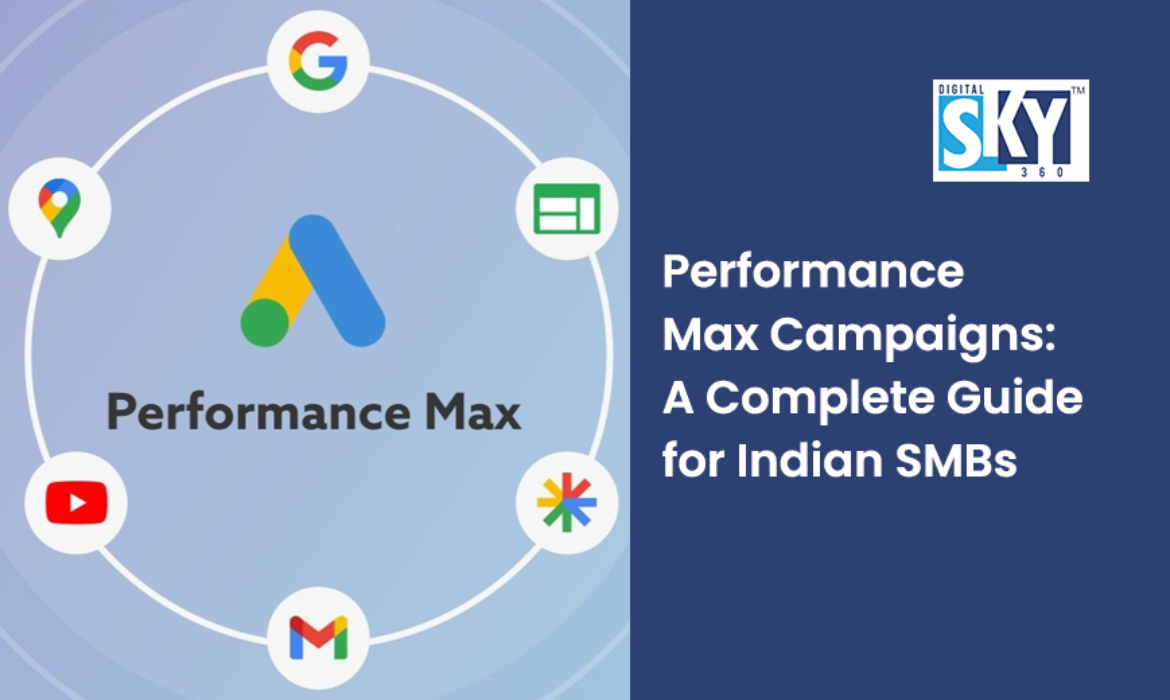
Performance Max campaigns (often called PMax) are Google’s all-in-one campaign type powered by machine learning. Launched globally in 2021 and now the dominant campaign format recommended by Google, PMax runs across every Google channel simultaneously:
- Google Search — Text ads triggered by relevant queries
- Google Shopping — Product listings with images and prices
- YouTube — Video ads before and during content
- Display Network — Banner ads across millions of websites
- Gmail — Sponsored emails in inbox tabs
- Google Maps — Local ads for discovery
One campaign. Every channel. One budget. The AI decides where your ads perform best and shifts spend accordingly — in real time, across billions of signals no human can manually process.
For Indian SMBs that lack the time or team to manage multi-channel advertising, this is genuinely transformative.
Why Performance Max Is Built for India’s Business Reality
Let’s be honest about something: most Indian small business owners don’t have a dedicated marketing team. They’re handling operations, supplier relationships, customer service, and marketing — often all at once. The idea of running separate Google Search, YouTube, and Display campaigns simultaneously is overwhelming.
PMax solves this problem structurally. But beyond convenience, it’s built for the nature of the Indian buyer’s journey.
Indian consumers are notoriously multi-touchpoint shoppers. They discover a product on YouTube while watching an unboxing video. They see a display ad the next morning on a news website. They Google the brand name three days later. They click a Shopping ad and finally purchase. That entire journey — every touchpoint — can now be managed, optimised, and attributed within a single Performance Max campaign.
Google’s AI tracks these journeys across devices and sessions. For a country where the average consumer switches between mobile, tablet, and desktop multiple times a day, this cross-device intelligence is invaluable.
The Building Blocks: Asset Groups
The heart of a PMax campaign is the Asset Group. Unlike traditional campaigns where you write ads for specific keywords, in PMax you provide a collection of creative assets and let Google’s AI assemble and test them dynamically.
Here’s what goes into a strong asset group:
Headlines (up to 15): Short, punchy, benefit-focused. Think: “Free Delivery Across India”, “Handcrafted Since 1998”, “Rated 4.8 by 10,000 Buyers”.
Descriptions (up to 4): 2–3 sentences elaborating on your offer. Focus on what makes you different.
Images (up to 20): Product photos, lifestyle imagery, behind-the-scenes content. Include both landscape (1.91:1) and square (1:1) formats. Quality matters enormously — blurry images drag down performance marketing across every channel.
Videos (up to 5): Even a 15-second product showcase shot on a smartphone outperforms having no video at all. Google auto-generates videos if you skip this — and those AI-generated videos are rarely great.
Logos and Business Name: These appear across Gmail and Display placements.
Audience Signals: This is where many Indian SMBs miss out. Audience signals are hints you give Google about who your ideal customer is — custom intent audiences, remarketing lists, customer email lists, in-market segments. You’re not restricting Google; you’re giving it a head start.
The more rich, relevant assets you provide, the more combinations Google can test, and the smarter the campaign gets over time.
Setting Up Your First Performance Max Campaign: Step by Step
Step 1: Define Your Conversion Goals
PMax is only as smart as the goals you give it. Before launching, make sure your Google Ads account has conversion tracking properly set up — purchases, form submissions, phone calls, whatever drives real business value. Without this, the AI is flying blind.
Step 2: Link Google Merchant Center (for e-commerce)
If you sell physical products, link your Merchant Center account before creating the campaign. This enables Shopping placements and significantly increases reach. Businesses running Google Ads for e-commerce in India without a Merchant Center connection are missing out on their highest-converting placements.
Step 3: Create Your Asset Group
Follow the asset group guidance above. Don’t rush this step. The quality of what you upload directly determines the quality of ads Google shows on your behalf.
Step 4: Set Budget and Bidding Strategy
For most Indian SMBs starting out:
- Maximise Conversion Value — best if your products or services have different price points.
- Maximise Conversions — best if your main goal is volume (leads, purchases) over value.
Avoid Target ROAS or Target CPA goals until you’ve accumulated at least 30–50 conversions. Setting ambitious targets too early causes the campaign to under-deliver.
Step 5: Define Location and Language
India is linguistically diverse. If your business serves specific regions, geo-target accordingly. A business in Tamil Nadu might find Hindi-heavy placements irrelevant. Precision here improves efficiency meaningfully.
What Performance Max Does Well — and Where It Struggles
Where PMax Shines
- New customer discovery: The Display and YouTube placements introduce your brand to people who’ve never searched for you. This is genuinely new demand generation.
- Remarketing at scale: PMax automatically re-engages past website visitors, cart abandoners, and existing customers without needing separate remarketing campaigns.
- Seasonal scaling: During Diwali, Navratri, or end-of-season sales, PMax adjusts spend dynamically toward your best-performing placements without manual intervention.
- Catching long-tail search queries: PMax can show ads for search terms that don’t exactly match any keyword in a standard Search campaign — valuable for niche products.
Where PMax Requires Caution
- Limited search term visibility: Unlike Search campaigns, PMax doesn’t show you a full list of every query that triggered your ad. You get a limited insights report. This opacity frustrates advertisers who want granular control.
- Brand name spend: PMax can aggressively bid on your own brand name, eating budget that would have converted organically. Add your brand terms as negative keywords or use brand exclusions.
- Creative fatigue: If you don’t refresh your asset groups every 4–6 weeks, performance can plateau. Fresh images and new headlines signal the algorithm and often unlock improvement.
A seasoned Google ads agency in Ahmedabad managing PMax accounts will typically audit asset quality scores, brand search cannibalisation, and campaign-level search term insights on a weekly basis.
Budget Guidance for Indian SMBs
How much should you spend? Here’s a realistic framework:
| Business Stage | Suggested Daily Budget | Goal |
| Just starting | ₹800 – ₹1,500/day | Data gathering, learning phase |
| Growing brand | ₹2,000 – ₹5,000/day | Optimise ROAS, expand reach |
| Scaling phase | ₹5,000+/day | Aggressive growth, new markets |
The learning phase typically lasts 2–4 weeks. During this time, resist the urge to make major changes. Changing budgets, bids, or asset groups frequently resets the learning algorithm and delays results.
If you’re unsure whether your current ad spend is working efficiently or going to waste, it’s worth reading about the Signs your Google Ads is wasting money before increasing budgets.
Performance Max + SEO: A Powerful Combination
Here’s something many Indian businesses overlook: paid and organic search don’t compete — they compound.
When you run PMax campaigns, Google Ads data reveals which product categories, messaging angles, and audience segments drive the highest conversion rates. That insight feeds directly into your organic content strategy.
Similarly, investing in Mobile-First SEO improves your landing page experience scores — which Google factors into ad quality and, by extension, your cost-per-click. A faster, mobile-optimised landing page means you pay less per click while converting more visitors. In India, where over 75% of web traffic is mobile, this is not optional advice.
How to Maximise Results: Expert Tips
1. Create Multiple Asset Groups by Theme Don’t mix all your products into one asset group. Create separate groups by category (e.g., “Men’s Footwear”, “Women’s Ethnic Wear”, “Kids’ Accessories”). Google can tailor creative more precisely.
2. Upload Customer Email Lists Even a list of 500 past customers gives Google’s AI powerful signal about your ideal buyer profile. It uses this to find “similar” users — a remarkably effective lookalike targeting mechanism.
3. Use Final URL Expansion Wisely PMax can dynamically change the landing page URL it sends traffic to based on relevance. This sounds helpful but can send traffic to wrong pages. Enable it carefully or turn it off until you’ve reviewed landing page quality.
4. Analyse the Insights Tab The Insights tab inside PMax campaigns shows audience segments, search categories, and asset performance ratings. Check it weekly. It’s your window into what the AI is learning.
5. Work With a Specialist A good PPC Marketing Company in Ahmedabad will know how to audit asset quality, set up proper conversion tracking, manage brand exclusions, and interpret PMax’s limited reporting — tasks that look simple but have outsized impact on ROI.
The Multi-Channel Strategy Indian SMBs Are Missing
Running Performance Max in isolation is fine. Running it as part of a coordinated strategy is significantly better.
Consider this sequence: A customer sees your YouTube ad through PMax, visits your website, leaves without buying. Your PMax campaign retargets them with a Display ad. They click, return, and this time they purchase after seeing a promotional Gmail ad.
That’s three channels, one campaign, zero manual management.
Now layer in the support of a digital marketing Agency in Ahmedabad that also manages your Meta ads, and you’ve created a full-funnel system that captures intent at every stage. Add a social media marketing Agency in Ahmedabad managing your organic content, and you’re building brand equity while your paid campaigns convert demand.
The businesses that will dominate Indian e-commerce in the next five years aren’t the ones with the biggest budgets. They’re the ones building the most integrated, data-driven growth systems.
Final Thoughts
Performance Max campaigns represent something genuinely new in digital advertising — a system where Google’s AI, your creative assets, and your business goals work together to find buyers across every channel simultaneously. For Indian SMBs that have been stuck running a single Search campaign and wondering why growth has stalled, PMax is worth taking seriously.
It’s not magic. It requires good data, quality creative, proper conversion tracking, and patience through the learning phase. But when those pieces are in place, the results can be remarkable.
Set it up right, feed it well, and let the AI do what AI does best — so you can focus on what you do best.
Frequently Asked Questions (FAQs)
Q1. Is Performance Max suitable for very small businesses with a limited budget in India?
Yes. PMax campaigns can run on budgets as low as ₹500–₹800 per day, though the learning phase is more effective with ₹1,000+ daily. The key is having proper conversion tracking in place, regardless of budget size.
Q2. Can Performance Max replace all my existing Google Ads campaigns?
Not necessarily. PMax works best alongside a branded Search campaign (to protect your brand terms) and can complement existing Shopping campaigns. It’s a powerful addition, not always a full replacement.
Q3. How long does the PMax learning phase last?
Typically 2–4 weeks. During this time, Google’s AI tests different asset combinations and identifies the best-performing audiences and placements. Avoid making major changes during this period.
Q4. Why is my Performance Max campaign spending mostly on one channel? This is normal early behaviour. Google’s AI allocates budget to where it finds the most conversion opportunities. If the distribution seems off long-term, review your asset quality and audience signals — both influence where the AI invests spend.
Q5. Do I need video assets for Performance Max?
Technically no, but strongly recommended. Without video, your ads won’t appear on YouTube — one of the most valuable channels in PMax. Even a simple 15–30 second product video shot on a smartphone significantly expands reach and improves overall campaign performance.